ResearchBlog6 min read
Filecoin’s provider exits and the risk of a shrinking network
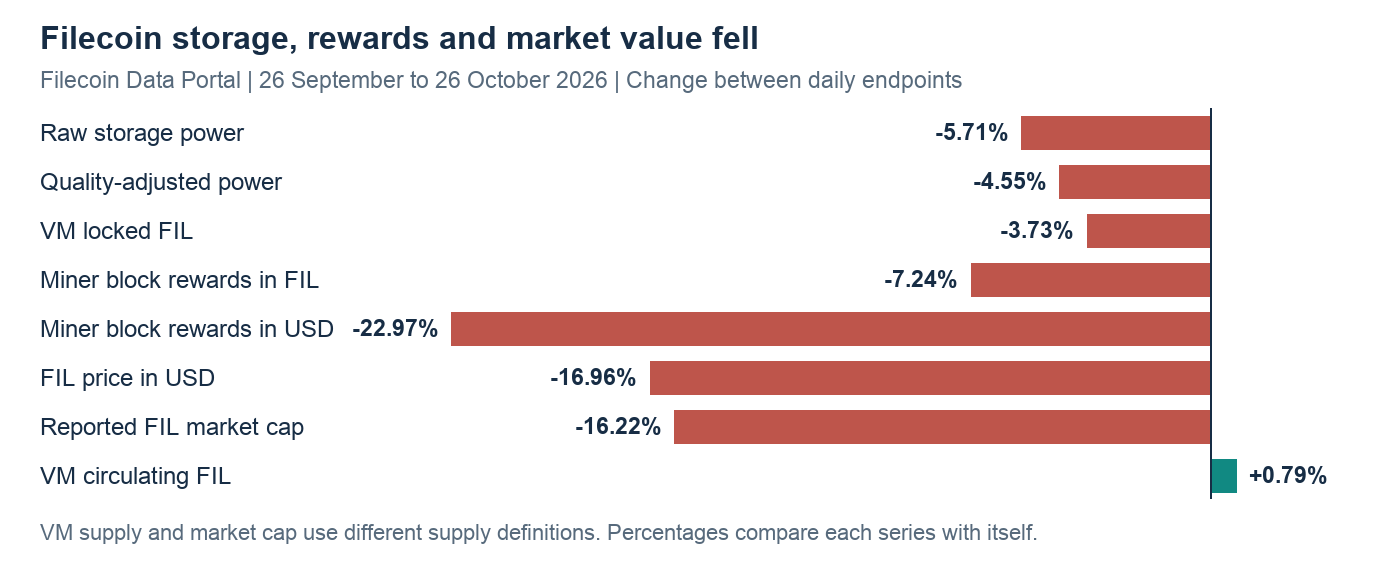
How Filecoin provider exits affect reward shares, pledge releases and renewal decisions, and what would establish a reinforcing exit cycle.
Read More
Expert analysis, research papers, and insights on tokenomics, protocol design, and the future of Web3 economies.
How Filecoin provider exits affect reward shares, pledge releases and renewal decisions, and what would establish a reinforcing exit cycle.
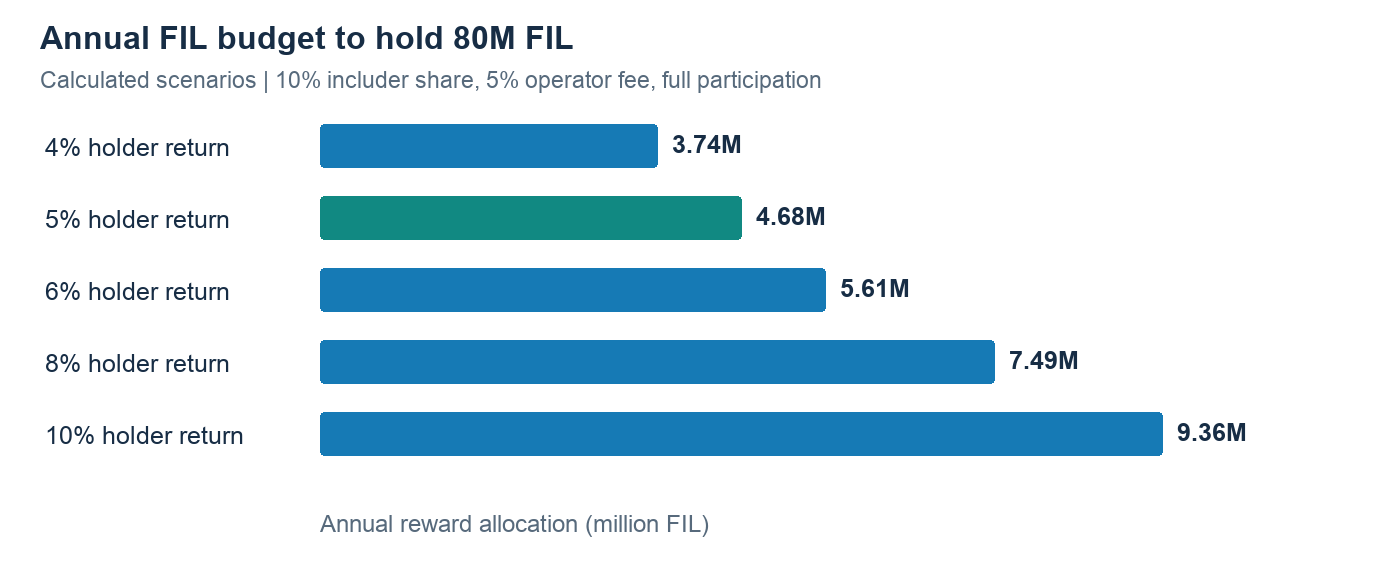
What an 80M FIL finality-staking target could cost under different holder returns, reward splits and funding choices.
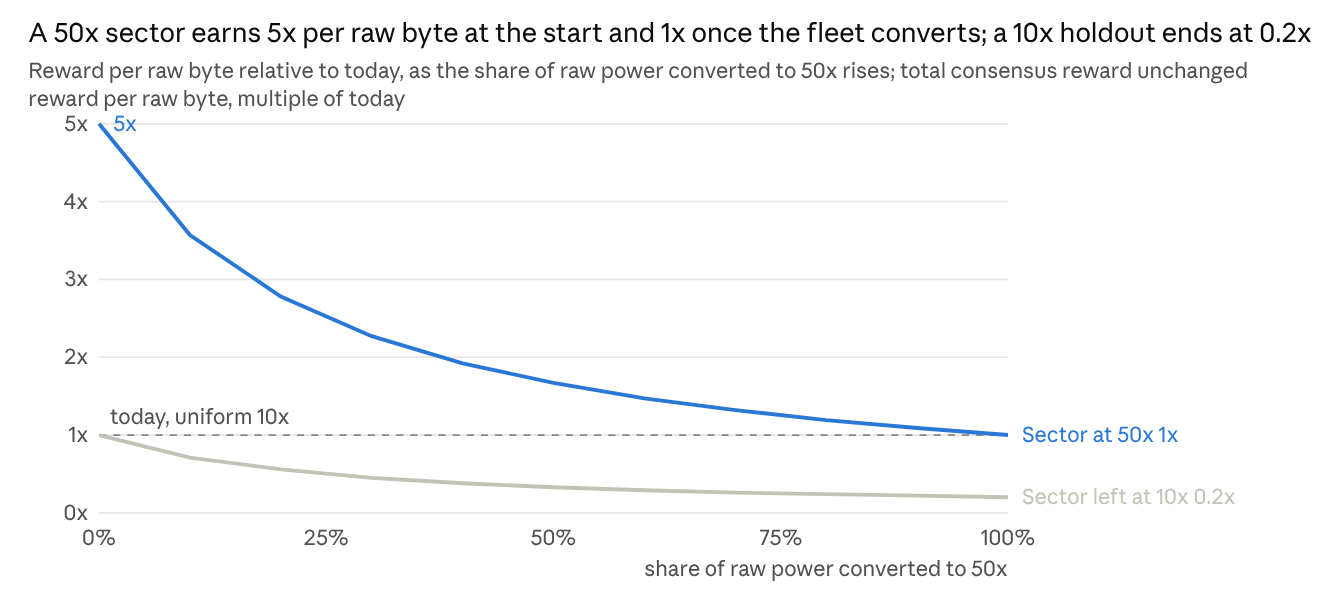
An exploration of a hypothetical 50x Filecoin quality multiplier: reward redistribution, entrant margins and pledge requirements.
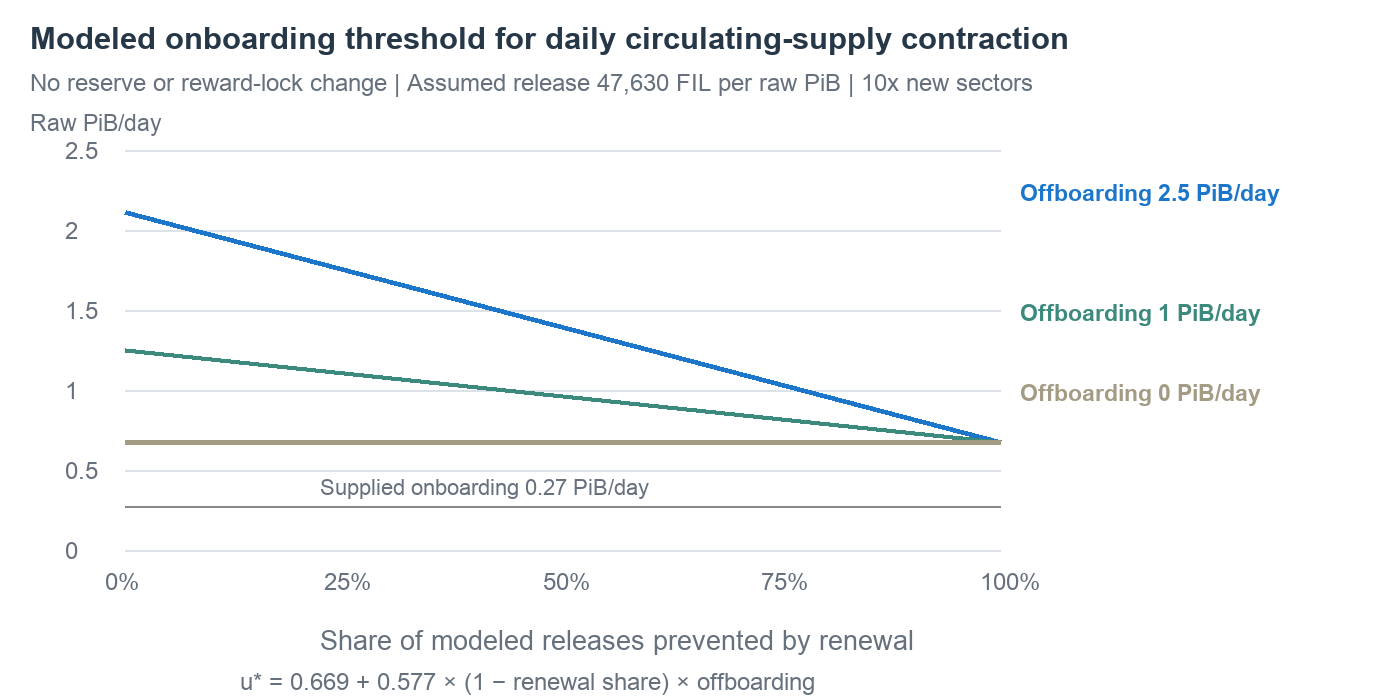
A scenario model of the onboarding, renewal and pledge flows needed for Filecoin’s circulating supply to contract after genesis vesting.
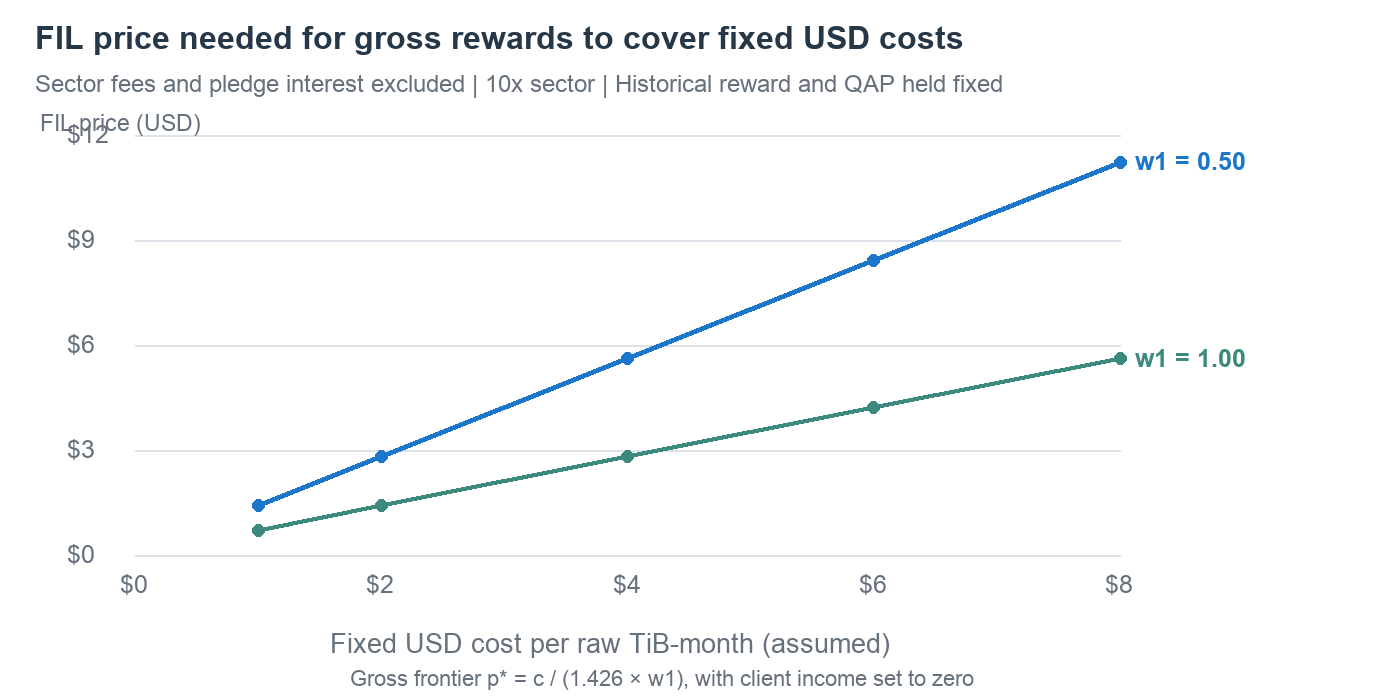
A fixed-input analysis of Filecoin initial pledge, storage-provider returns, financing costs and the conditions for network growth.
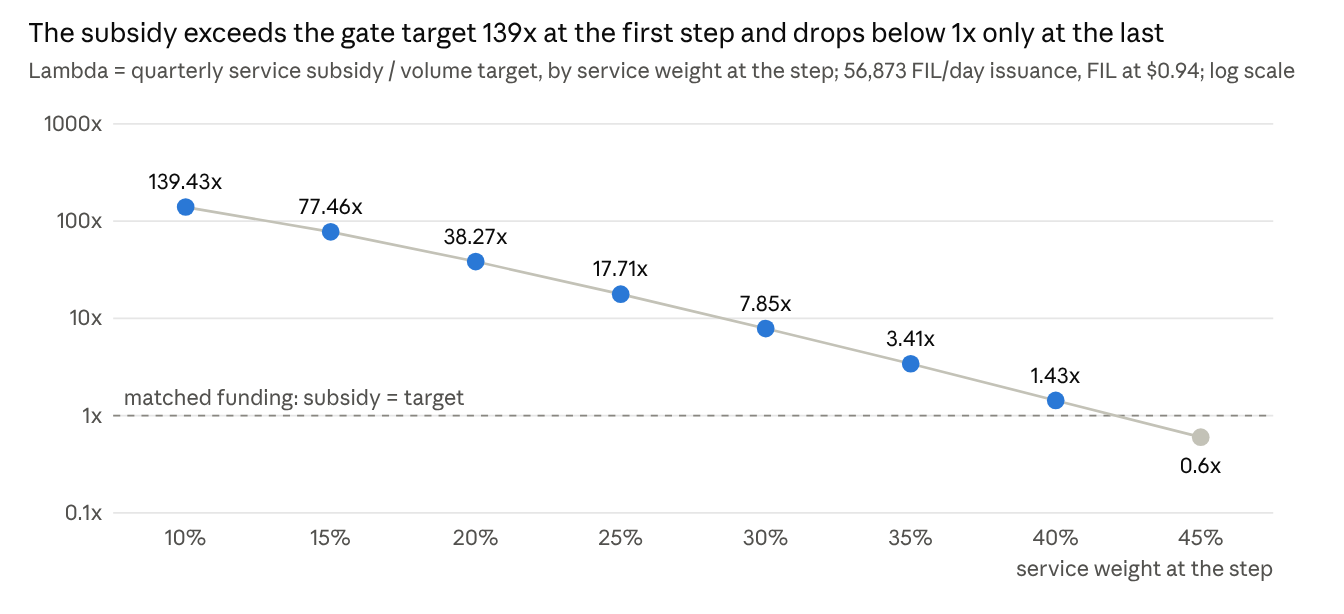
How Filecoin’s Solstice volume gates allocate rewards between services and burn, and what alternative target calibrations imply.

We reviewed the FIP-100 community dashboard ten months after activation. Batching adoption surged, but the network's structural challenges — declining SPs, flat power, reduced onboarding — remain unchanged.

Hellas makes off-chain tensor compute economically verifiable. Providers post collateral, deterministic execution enables fraud proofs, and cheating becomes unprofitable.

Cryptoeconomic research on Hellas, a decentralized network that makes off-chain tensor compute economically verifiable through deterministic execution and fraud proofs.

Most tokenomics fail not from bad math but from misaligned incentives. Here's the framework we use across 20+ protocol engagements to design token economies that actually work.

Emission schedules determine when tokens enter circulation—and they're one of the hardest parameters to change post-launch. Here's how the major models compare and when to use each one.

A tokenomics audit isn't a code audit. It examines whether your token economy's incentives, supply dynamics, and governance mechanisms will hold up under real-world conditions. Here's exactly what we evaluate.

AutoCap introduces an action-first approach to Filecoin Plus DataCap allocation. Instead of requesting DataCap upfront, participants earn it by using Filecoin Pay and settling payments on-chain.

EconoLens combines DeepSeek V3 with MechaFIL to provide Filecoin economic forecasts, network metrics analysis, and tokenomics modeling through a conversational interface. Ask questions in plain English and get data-backed forecasts with interactive charts.

A guide to how MiCA (Markets in Crypto-Assets) regulation affects token design, classification, and compliance for projects launching in the EU.

We've analyzed vesting structures across dozens of protocols. Here's what separates schedules that build sustainable communities from those that create cliff-day crashes.

Curve's veCRV pioneered a new tokenomics primitive. We break down why it works, where it breaks, and what protocols get wrong when adopting it.

We've seen the due diligence checklists. Here are the tokenomics patterns that get projects rejected before the first call.

Revnets are autonomous, tokenized financial structures that route revenue through immutable smart contracts. Our analysis reveals four mathematical guarantees: rising price floors, tunable monetary policy, guaranteed capital access, and provably solvent loans.

As intelligent systems enter the physical world, coordination—not control—becomes the next scalability limit. This essay lays out how DePAI enables verifiable, incentive-aligned cooperation.

Comprehensive study of the Revnet protocol cryptoeconomics, including analysis, dynamical system modeling, and whitepaper. This research examines the economic mechanisms and incentive structures of the Revnet protocol.

The $1.4 billion event highlights an important trade-off in token launches. We analyze the auction data and explore alternative frameworks for achieving fair distribution and post-launch stability.

Discover how Impact Evaluators solve the public goods funding problem by creating positive feedback loops that reward measurable impact, with TIG as a real-world example.

A deep dive into how TIG and CryptoEconLab collaborated to create mission-aligned tokenomics through the Gamma Upgrade, transforming token distribution to reward real algorithmic innovation.

Part 1 of 2: How DeFi access fundamentally changes corporate treasury strategy. Companies are pivoting from Bitcoin to Ethereum for programmable financial infrastructure.

Quantitative analysis of how layer-1 blockchains can align layer-2 solutions through token grants, time vesting, and buy-back-and-burn mechanisms.

The May 2022 Shanghai panic revealed a critical flaw in DeFi: traditional CDP parameters don't work for liquid staking tokens. Our interactive simulator shows why LST collateral needs different risk management than ETH.

Research paper proposing a new token distribution mechanism designed to align token allocation with protocol mission and impact.

Economic analysis and risk assessment for Secured Finance, including simulation models and protocol economics evaluation.

Technical whitepaper detailing the DCIPHER protocol's cryptographic economic design and incentive mechanisms.

Complete technical documentation for the Checker Network protocol, covering tokenomics, governance, and security verification mechanisms.

Technical documentation for the Lighthouse storage protocol, including economic models and permanent storage mechanisms.

An in-depth analysis of the funding allocated to projects in FIL-RetroPGF-3, comparing results to previous rounds and exploring the evolution of the RetroPGF mechanism.

Interactive simulation tool for exploring token economics and emission schedules for the Lighthouse $House token.

An in-depth analysis of the funding allocated to projects in FIL-RetroPGF-2, comparing results to Round 1 and exploring exciting developments for Round 3.

An in-depth analysis of how different voting mechanisms perform when voters have conflicting interests, with implications for DAO governance and protocol design.

Protocol documentation for Nosh, a decentralized physical infrastructure network for local services and commerce.

We introduce a quantitative framework to compare pairwise voting to Quorum+Threshold mechanisms for RetroPGF funding allocation, showing that pairwise voting can allocate capital more efficiently while being more robust to badgeholder laziness and expertise limitations.

Interactive tool for exploring storage provider costs and economics within the Filecoin decentralized storage network.

Analysis of how value accrues to the Filecoin network and token holders through protocol economics and network growth.

Detailed analysis of the first Filecoin Retroactive Public Goods Funding round, examining distribution mechanisms and outcomes.

Technical exploration of stable aggregate currency design, combining multiple stablecoins into a single stable aggregate token.

Retroactive public goods funding platform for the Filecoin ecosystem, enabling community-driven value distribution.

Analysis of Filecoin's fully diluted valuation metrics and their implications for token economics and network valuation.

Introduction to Filecoin's Retroactive Public Goods Funding mechanism and its role in supporting ecosystem development.

Analysis of Safe's token design and governance mechanisms, examining how the protocol structures value accrual and stakeholder alignment.

Interactive visualization and simulation tool for exploring Filecoin token supply dynamics and emission schedules over time.

Academic research paper presenting a framework for modeling utility-based cryptoeconomies using agent-based simulation techniques.

Open-source mechanistic model of the Filecoin network built with JAX, enabling differentiable simulations for protocol optimization.

Comprehensive almanac of cryptoeconomic resources, research, and documentation compiled by the CryptoEconLab team.
Subscribe to our newsletter to be notified when new insights and research are published.