Raising the quality multiplier from 10x to 50x: an idea exploration





Abstract
This article tests a hypothetical 50x multiplier. A uniform change leaves the consensus reward pool unchanged. A small entrant initially receives five times a comparable 10x sector’s reward and needs five times its pledge. At the reference inputs and assumed 10% finance, its margin after fees and interest but before hardware is $3.31 per raw TiB-month at w₁ = 1 and slightly negative at w₁ = 0.5. These are static entry margins. At fixed circulating supply, a uniformly renewed 10x fleet needs about 99M FIL of initial pledge and a 50x fleet about 159M, a difference near 60M before feedback.
1. What a multiplier can and cannot do
Conservation. Sector i with raw bytes qᵢ and multiplier κᵢ has QA power κᵢqᵢ, and the network’s QA power is Q = Σκᵢqᵢ. Expected consensus income is proportional to QA share, so
The multiplier moves reward between sectors in proportion to κᵢ/κ̄, where κ̄ = Q/P_raw is the fleet’s power-weighted mean. A uniform change of κ leaves every sector’s income unchanged. A non-uniform change is a transfer.
The baseline channel is closed. The only way issuance depends on power is through effective network time in the reward actor, and the power actor reports raw byte power, not QA power, to that calculation (actors/power/src/lib.rs, this_epoch_raw_byte_power passed to UpdateNetworkKPI):
The minting equation uses raw power. A quality multiplier therefore does not directly change issuance for a fixed raw-power path. At 1,300 raw PiB against a baseline near 167,800 PiB, raw power is well below baseline. Indirect effects through entry or exit would require a separate power forecast.
What is left. Three quantities depend on κ:
-
The distribution of a fixed w₁R across sectors, by κᵢ/κ̄.
-
The pledge per raw byte, through the baseline term 0.21 CS κ/B, which scales with κ because B is exogenous, while the simple term 0.09 CS κ/Q is invariant once Q has scaled with κ.
-
The daily fee per raw byte, φ_f CS κ, which scales with κ and is capped at 50% of a sector’s expected reward.
A multiplier can change relative reward shares during conversion and collateral requirements. The effects on entry and net locking depend on the transition path.
2. The cost of producing a FIL
Define average hardware-and-operating cost per FIL as the fixed USD cost of the fleet divided by its consensus reward. This is a unit-cost calculation, not a measured marginal production cost; it excludes sector fees and pledge financing:
with c the USD cost per raw TiB-month of hardware, data-centre space, power and operations. κ does not appear: multiplying every byte’s quality by the same factor changes neither the bytes nor the reward. The cost of production is a property of the fleet’s size and cost structure relative to issuance, and the multiplier is a rule for sharing issuance within the fleet.
| Cost c per raw TiB-month | C_FIL at w₁ = 1.0 | C_FIL at w₁ = 0.5 | Versus $0.94 |
|---|---|---|---|
| $1 | $0.77 | $1.54 | Below price today, above at the floor |
| $2 | $1.54 | $3.08 | Above price |
| $4 | $3.08 | $6.15 | Above price |
| $6 | $4.61 | $9.23 | Above price |
Before sector fees and pledge financing, the reference gross fleet reward covers $1.22 per raw TiB-month at w₁ = 1 and $0.61 at w₁ = 0.5. Applying the fleet-average quality ratio to new pledge terms and assuming 10% borrowing leaves about $0.60 before hardware in the unsplit case and approximately zero at the floor. These are scenario margins. The snapshot does not establish the cost distribution across providers or their actual loan rates.
The dilution argument, stated and tested. The argument is that a higher κ spreads a fixed hardware cost over more reward. Per raw TiB the reward is
Reward per raw TiB = w₁Rκᵢ / (1,024Q) = [w₁R / (1,024P_raw)] × (κᵢ/κ̄)
A sector whose κᵢ exceeds the fleet mean earns more reward per raw byte than the fleet average. That advantage comes from other sectors’ smaller shares of the same reward pool. A uniform multiplier change cannot improve the fleet-wide gross reward per raw byte. Client-revenue effects, changes in costs and the effect of a different collateral requirement are separate mechanisms.
The marginal entrant. The network-level result does not settle the onboarding decision, which the marginal entrant makes. While the fleet is still at 10x, a 50x entrant has κᵢ = 5κ̄, so its reward per raw TiB is five times today’s. So are its daily fee and its pledge, since all three scale with κ while Q is unchanged. Its margin per raw TiB before hardware is therefore proportional to κ (r_p − r_b) ip, where the FIL-on-FIL return r_p is unchanged by the multiplier and r_b is the borrowing rate. 50x multiplies the spread by five. Margin per raw TiB-month before hardware, USD, after the daily fee:
| w₁ | 10x, 5% loans | 10x, 10% loans | 50x entrant, 5% loans | 50x entrant, 10% loans |
|---|---|---|---|---|
| 1.00 | $0.98 | $0.66 | $4.89 | $3.31 |
| 0.75 | $0.64 | $0.33 | $3.21 | $1.64 |
| 0.50 | $0.31 | −$0.01 | $1.54 | −$0.04 |
In the w₁ = 1 reference case with assumed 10% FIL loans, the small 50x entrant has $3.31 per raw TiB-month left after the sector fee and interest. That covers an assumed $2 to $3 hardware-and-operating cost in this static example. It does not establish loan availability or a positive lifetime return as more sectors convert. At the 50% consensus floor the modeled margin is slightly negative before hardware.
3. 50x against 10x: transition, pledge, and who gains
Transition. Let s be the share of raw power converted to 50x, so κ̄(s) = 10(1 − s) + 50s. A converted sector earns 50/κ̄(s) times today’s reward per raw byte and an unconverted one 10/κ̄(s):
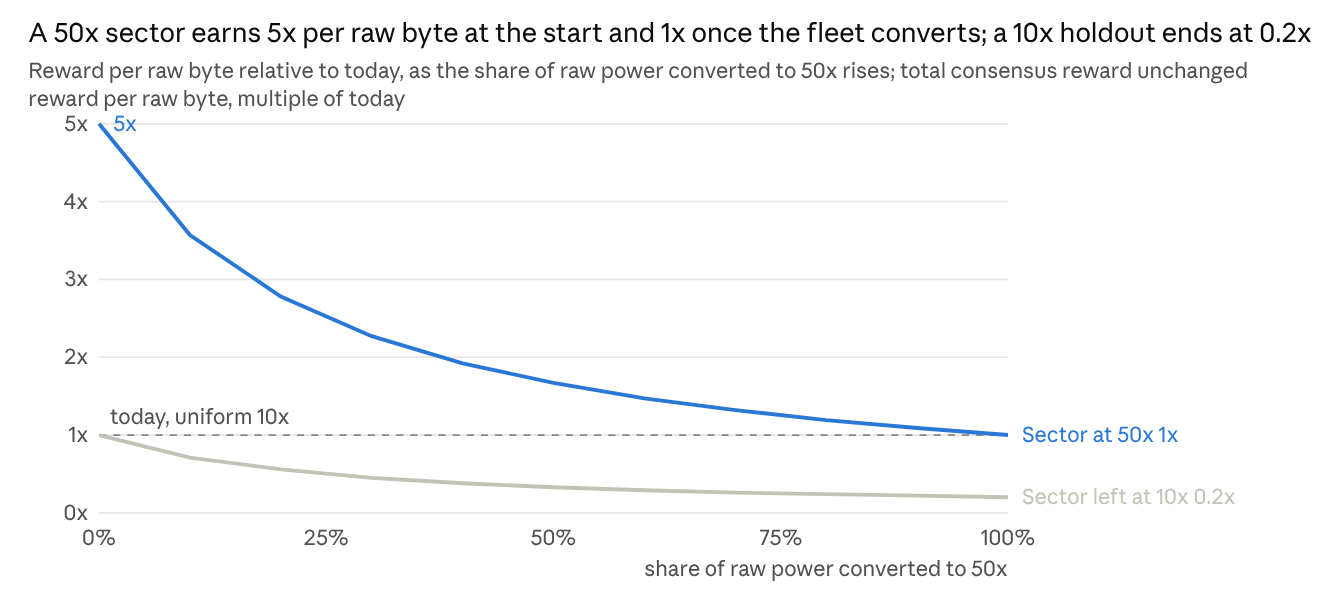
Reward share identity with a 10x fleet converting to 50x; pledge figures from Article 2’s decomposition at late-October 2026 inputs
In the uniform-10x transition model, relative reward is 5/(1 + 4s). It falls from 5x to 2.5x at 25% conversion, and to 1.67x at 50%. The initial fivefold level has fallen about 29% at 10% conversion. Conversion speed depends on financing, quality-upgrade implementation and operating capacity. The historical 0.27 PiB/day onboarding rate alone does not forecast an upgrade schedule.
Pledge per raw PiB. Using Article 2’s decomposition with the simple term scaling as κ/Q and the baseline term as κ/B:
| State | Q (PiB) | Simple term per raw PiB | Baseline term per raw PiB | Storage pledge | Total pledge per raw PiB |
|---|---|---|---|---|---|
| 10x new sector at snapshot inputs | 11,857 | 70,010 | 11,540 | 960 | 82,510 FIL |
| Small 50x entrant at snapshot QAP | 11,857 | 350,050 | 57,700 | 4,800 | 412,550 FIL |
| 50x, whole fleet converted | 65,000 | 63,850 | 57,700 | 875 | 122,500 FIL |
After full conversion, the simple and storage pledge terms depend on raw fleet size; the baseline term scales with κ. At fixed circulating supply, a uniformly renewed 10x fleet needs about 99M FIL of initial pledge and a 50x fleet about 159M. The multiplier adds about 60M. The arithmetic difference between 159M and the reported 61.9M legacy collateral stock is about 97M, but that comparison includes repricing and requires matching the stock’s treatment of locked rewards. It is not a measured net lock forecast. New locks also lower circulating supply and subsequent pledge requirements. The table’s whole-fleet storage term is about 875 FIL per raw PiB.
Who gains. Three groups, with signs:
-
Entrants and early upgraders: reward per raw byte up to 5x during the transition; pledge per raw byte 5x during it and 1.5x after; net present value positive only if conversion is slow and their capital cost low. The pledge is returned at expiry, so the cost is the carry on 412,550 FIL per PiB, not the principal.
-
Non-upgrading 10x incumbents: reward per raw byte falls toward 0.2x as s → 1. This is the transfer that funds the entrants. Incumbents with sectors near expiry cannot upgrade without a top-up they may not have; the ramp of w₁ is simultaneously halving the income that would service it.
-
The quality-only difference is about 46,000 FIL per raw PiB repriced, or 60M FIL across the reference fleet, before feedback. The broader 97M arithmetic comparison is about 75,000 FIL per PiB and includes legacy repricing and any stock-definition mismatch. Daily supply effects depend on the pace of conversion, sector releases, locked rewards, minting and burn.
4. Assessment
The network-wide result differs from the initial margin of a small entrant.
Before fees and finance, reference gross rewards cover about $1.22 per raw TiB-month for the fleet, or $0.61 at the 50% consensus floor. The cost distribution across providers is not measured here. For a fixed fleet and reward pool, C_FIL = 0.769c/w₁ contains no quality multiplier. A small 50x entrant initially receives a larger reward share while locking more pledge. Its operating margin improves only if the resulting reward exceeds fees, finance and hardware costs.
The transition can improve early entrants’ reward per byte while reducing holdouts’ share. Entry depends on finance, costs and conversion speed. The initial fivefold reward level halves at 25% conversion in the uniform-10x model. The quality-only pledge difference is about 60M FIL before circulating-supply feedback. Adoption and sufficient net locking are required for supply contraction.
The model separates reward allocation from collateral. Gross fleet reward per byte depends on w₁R/P_raw. A quality multiplier changes relative shares during transition and the pledge required per raw byte. Changing pledge weights directly would affect collateral without the same transition in relative rewards. These calculations do not estimate the price response to locking FIL or establish that a larger lock would restart network growth.
Parameters and sources. The economic inputs are the historical late-October values supplied with the draft. Costs, financing rates, eligible quarterly volume and full-fleet repricing are labeled scenario assumptions. Code and proposal links below support the mechanism; the historical dashboard values should be retained with their date when publishing.
Shared data snapshot (Filecoin Data Portal, late October 2026)
| Quantity | Value |
|---|---|
| Circulating supply | 922.35M FIL |
| Pledge collateral | 61.93M FIL (6.71% of circulating) |
| Raw byte power | 1,300 PiB |
| Quality-adjusted power | 11,857 PiB |
| Onboarding | 0.27 PiB/day |
| Block reward | 56,873 FIL/day |
| Burn | 1,661 FIL/day |
| FIL price | $0.94 |
| Filecoin Pay gross payment run rate | $136K to $144K per year |
| Filecoin Pay network fee ARR | $681 |
| Baseline power at 6.03 years | 167,800 PiB |
| Vesting | Ended October 15, 2026 (about 185,000 FIL/day before) |
Code basis is builtin-actors v19.0.1 and Lotus v1.37.0. Onboarding uses raw bytes. Costs of $1 to $8 per raw TiB-month and FIL borrowing rates of 5% to 10% are scenario assumptions, not audited provider costs or executable loan quotes. Dollar and annualized results hold the stated issuance, price and supply fixed unless a time path is specified. The shared snapshot is historical; this review does not replace it with November market data.
The Filecoin economics series
- The Solstice volume gate: subsidy, inflation and the calibration of targets
- Initial pledge per QAP, storage-provider returns and the growth condition
- Conditions for a daily contraction of circulating supply
- Raising the quality multiplier from 10x to 50x: an idea exploration
Source links
Filecoin Data Portal numbers and metric definitions
FIP-0118 reward split, eligible volume and gate timing
FIP-0081 initial pledge decomposition
FIP-0100 sector fee and circulating-supply discussion
builtin-actors v19.0.1 miner pledge and fee code
Discuss This Article With AI
Get instant analysis and insights from leading AI assistants
How We Can Help
Interested in similar solutions for your project? Explore our related services: