The Solstice volume gate: subsidy, inflation and the calibration of targets





Abstract
FIP-0118 redirects up to half of block rewards from storage consensus to services. Its first gate raises the service share from 10% to 15% after a measured quarter clears $3,500 of eligible volume. Later targets grow 2.7x per step. At 56,873 FIL/day and $0.94, each 5-point increment is worth about $244K per quarter. The first five targets are below that one-quarter increment. The 139x first-row ratio compares the standing service budget with the target; the marginal increment is 70x. Passing a gate creates an ongoing percentage allocation under the current schedule, not a fixed dollar payment forever. We compare alternative calibration rules and the burn forgone when gates pass, with payment eligibility and governance restrictions held explicit.
1. Mechanism and the subsidy-to-volume ratio
Let R be gross block reward, R_Q its quarterly sum, and p the illustrative $0.94 market price used to value rewards. This valuation differs from the fee-auction conversion rule for FIL-denominated gate volume. The reward actor allocates w₁R to miners, w₂R to services and the remainder to burn. The compact schedule below omits intra-quarter ramping and the roughly 17-day minimum reporting and activation delay after a measured quarter closes:
w₁(k) = max(0.50, 0.95 − 0.05k) [quarter-boundary approximation]
w₂ starts at 5%, reaches 10% ungated, then rises 5 points per passed gate, capped at 50%.
The quarterly subsidy that a service weight w₂ pays out is S(w₂) = w₂ R_Q p, and the marginal subsidy of one step is ΔS = 0.05 R_Q p. The object of interest is the ratio of what a step pays to what it demands:
With R = 56,873 FIL/day (R_Q = 5.19M FIL) and p = $0.94, R_Q p = $4.88M per quarter, and the ladder reads:
| w₂ at step | Subsidy S(w₂) per quarter | Target T(w₂) to step up | Λ = S/T | Marginal ΔS / T |
|---|---|---|---|---|
| 0.10 | $488K | $3.5K | 139 | 70 |
| 0.15 | $732K | $9.45K | 77 | 26 |
| 0.20 | $976K | $25.5K | 38 | 9.6 |
| 0.25 | $1.22M | $68.9K | 17.7 | 3.5 |
| 0.30 | $1.46M | $186K | 7.9 | 1.3 |
| 0.35 | $1.71M | $502K | 3.4 | 0.49 |
| 0.40 | $1.95M | $1.36M | 1.44 | 0.18 |
| 0.45 | $2.20M | $3.66M | 0.60 | 0.07 |
Λ compares the standing service budget with the target for its next 5-point increment. It is not the marginal incentive ratio. At 10% service weight, the standing budget is $488K and the next increment is $244K against a $3.5K target. The first four gates take the share from 10% to 30%. A repeated $36K quarterly volume scenario can pass the first three gates, one per quarter, provided that volume qualifies under the registered-pair, settlement and verification rules. Global Filecoin Pay volume does not establish that qualification. The marginal ΔS/T ratio exceeds one for the first five gates at the frozen issuance and price. This identifies a possible incentive to manufacture volume, not evidence that manipulation has occurred; governance can remove self-dealing participants.
2. Inflation accounting
The split does not directly change the minting formula for a fixed raw-power path. Annualizing the reference reward gives I = 20.76M FIL, or 2.25% of the snapshot circulating supply. The table compares terminal weights at that frozen issuance rate, assuming a valid service distribution. It does not show the ramp’s timing, reward decay, indirect changes in raw power, or net circulating-supply growth after pledge changes.
| Path | w₁, w₂, w₀ at steady state | Issuance to supply (FIL/yr) | Gross rate on CS | Form of the non-miner part |
|---|---|---|---|---|
| Pre-Solstice reference | 1.00, 0, 0 | 20.76M | 2.25% | 75% of reward vests over 180 days |
| Gate passes every quarter | 0.50, 0.50, 0 | 20.76M | 2.25% | 10.38M/yr unvested to orchestrator wallets |
| Volume flat at $36K/qtr | 0.50, 0.25, 0.25 | 15.57M | 1.69% | 5.19M/yr unvested; 5.19M/yr burned |
| Gate never passes after Q1 | 0.50, 0.10, 0.40 | 12.46M | 1.35% | 2.08M/yr unvested; 8.30M/yr burned |
A passed gate redirects an additional 5% of the reward from the residual burn stream to service accrual under the stated schedules. Burn also occurs during the ramp when continuous consensus-weight reductions run ahead of discrete service steps, even if gates pass. Missing or zero service allocations can add burn. The terminal all-pass state has no scheduled residual burn. The annualized effect of one increment at the reference reward is
ΔI_step(t) = 0.05 × I(t) ≈ 1.04M FIL/year at the reference issuance
Three gates passed in the repeated eligible-$36K scenario reduce terminal burn by about 3.11M FIL a year at the reference issuance, or 0.34% of snapshot circulating supply. These are run rates, not fixed future payments. Discounting a constant 5% share as a perpetuity would value it at 10.4M FIL at a 10% discount rate. If the underlying reward instead decays with a six-year half-life, the continuous approximation is 0.05I / (0.10 + ln(2)/6), about 4.82M FIL. Actual baseline rewards and future governance can change that path.
Locked miner rewards affect both spendable FIL and the VM circulating-supply input. At constant rewards, 75% vesting linearly over 180 days holds roughly 67.5 times daily miner rewards, or 3.84M FIL in the unsplit reference. Halving miner rewards lowers that steady-state balance to about 1.92M FIL. This stock difference is an illustration, not a measured release forecast. Miner reward locks are included in the power actor’s pledge total. Service rewards are unvested but become spendable by recipients through the claim process.
Liquid reward flow ≈ (1 − w₀) × I − change in the miner reward-vesting stock
At frozen issuance, moving from the unsplit reference to a 50% consensus share removes 10.38M FIL a year of miner reward, about $9.8M at $0.94. The service share or burn receives the balance. This compares reward allocations, not provider profit or immediate liquid issuance. Article 2 examines financing and hardware costs.
3. Target calibration
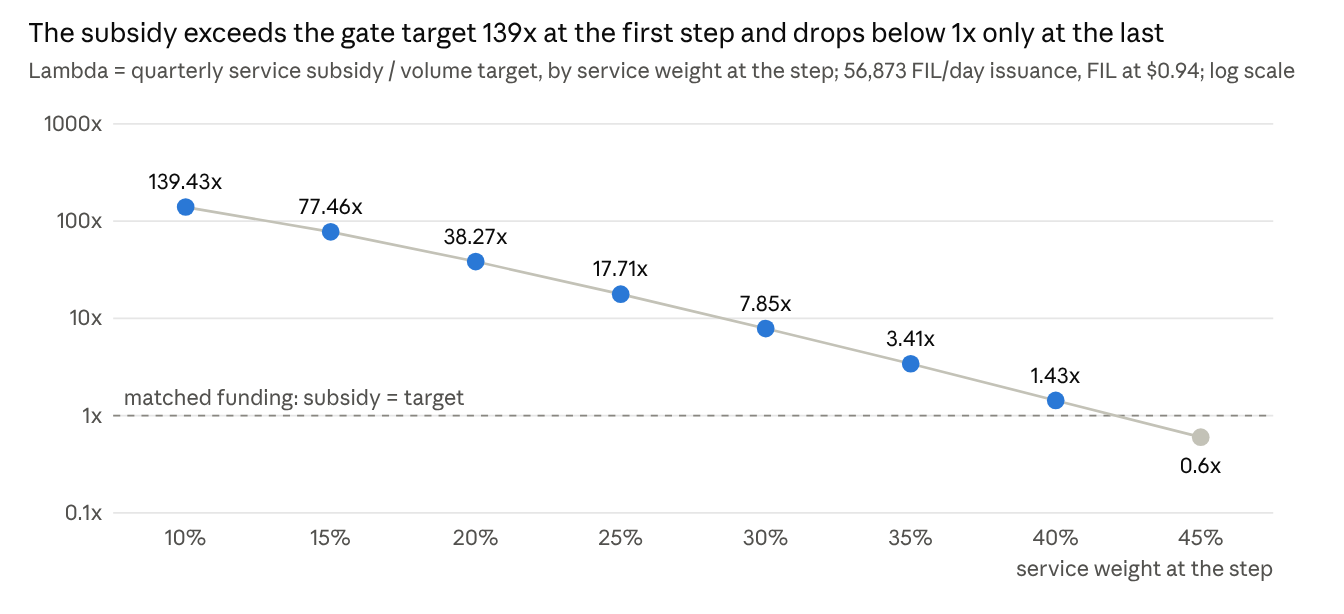
FIP-0118 target schedule; issuance and price from the Filecoin Data Portal, late October 2026
Matching the target to the standing 10% service budget would set the first threshold near $488K. Matching the entire post-step 15% budget would instead require about $732K. Neither is the $244K marginal increment. These are different calibration choices. A hypothetical $36K of eligible quarterly volume clears no gate under either full-budget rule, leaving the service weight at 10% and terminal residual burn at 40%.
Three calibration rules can be written down, each with a different notion of what the volume gate is for.
Standing-budget matching. If eligible quarterly volume must cover the service allocation at the weight before the next gate, the threshold is S(w₂)/μ:
At μ = 1 this standing-budget rule gives $488K for the first gate and $1.22M for the fourth. It does not require volume to cover the larger budget after the increment. A post-step budget rule would use S(w₂ + 0.05)/μ and start at $732K. Under either rule, the repeated $36K eligible-volume scenario leaves the service share at 10% and terminal residual burn at 40%.
Revenue coverage. If the subsidy should be fundable from protocol revenue the volume generates, with a network fee rate f on settled volume:
The snapshot pairs $681 of annualized network fees with $136K of gross annualized payment volume, an effective rate near 0.5%. At that rate, covering a $488K quarterly standing service budget from protocol fees needs about $98M in quarterly payments. This is a sensitivity calculation. Gross payment volume and protocol revenue are different measures, and the historical run rate does not establish qualifying gate volume.
Growth indexing. If the gate is meant to reward demand growth rather than a level, index each quarter’s target to the previous quarter’s realised volume:
A growth index makes the threshold depend on the previous quarter’s eligible volume rather than a fixed dollar ladder. With g > 1, flat volume fails. Small starting volumes and concentration in a large payer can still make measured growth volatile; a growth index does not establish customer independence or exclude circular payments.
The FIP uses a step-indexed dollar ladder, not a requirement that volume covers subsidies or protocol fees. Targets rise only after a pass. Passing one gate per quarter requires 2.7⁴, about 53 times, annual volume growth after bootstrap. The first five targets are below one quarter of their incremental reward at the reference price. The schedule is intended to fund early service growth; that design choice also creates a gap between the volume required and the subsidy allocated.
4. Discussion
The volume gate controls allocation between service rewards and burn. It does not directly increase gross minting for a fixed storage-power path.
The material comparison is the amount burned under a binding gate versus the amount accrued to services after a pass. Fixed annualized figures describe the snapshot; future FIL and dollar amounts depend on issuance and price.
Under the repeated eligible-$36K scenario, three gates eventually lift the service share to 25%. At the 50% consensus floor, the remaining 25% still burns, about 5.19M FIL a year at frozen issuance. This is 3.11M FIL less burn than the 40% terminal-burn case. A pass also shifts rewards from vested miner income toward unvested service accrual. The low early targets create a potential incentive to manufacture volume, but the reward is shared, eligibility must be verified, and self-dealing can lead to removal. A subsidy-to-target ratio alone cannot establish an exploitable profit or actual misconduct.
One calibration scenario combines standing-budget matching with growth indexing, T_k = max(w₂R_Qp/μ, gV_(k−1)). A post-step-budget version substitutes w₂ + 0.05. Both make the required volume scale with the subsidy and with prior demand. The trade-off is a harder bootstrap. Their effect depends on the chosen subsidy multiple μ, growth factor g and verified eligible volume, rather than gross payment run rate alone.
Shared data snapshot (Filecoin Data Portal, late October 2026)
| Quantity | Value |
|---|---|
| Circulating supply | 922.35M FIL |
| Pledge collateral | 61.93M FIL (6.71% of circulating) |
| Raw byte power | 1,300 PiB |
| Quality-adjusted power | 11,857 PiB |
| Onboarding | 0.27 PiB/day |
| Block reward | 56,873 FIL/day |
| Burn | 1,661 FIL/day |
| FIL price | $0.94 |
| Filecoin Pay gross payment run rate | $136K to $144K per year |
| Filecoin Pay network fee ARR | $681 |
| Baseline power at 6.03 years | 167,800 PiB |
| Vesting | Ended October 15, 2026 (about 185,000 FIL/day before) |
Code basis is builtin-actors v19.0.1 and Lotus v1.37.0. Onboarding uses raw bytes. Costs of $1 to $8 per raw TiB-month and FIL borrowing rates of 5% to 10% are scenario assumptions, not audited provider costs or executable loan quotes. Dollar and annualized results hold the stated issuance, price and supply fixed unless a time path is specified. The shared snapshot is historical; this review does not replace it with November market data.
The Filecoin economics series
- The Solstice volume gate: subsidy, inflation and the calibration of targets
- Initial pledge per QAP, storage-provider returns and the growth condition
- Conditions for a daily contraction of circulating supply
- Raising the quality multiplier from 10x to 50x: an idea exploration
Source links
Filecoin Data Portal numbers and metric definitions
FIP-0118 reward split, eligible volume and gate timing
FIP-0081 initial pledge decomposition
FIP-0100 sector fee and circulating-supply discussion
builtin-actors v19.0.1 miner pledge and fee code
Discuss This Article With AI
Get instant analysis and insights from leading AI assistants
How We Can Help
Interested in similar solutions for your project? Explore our related services: