Conditions for a daily contraction of circulating supply





Abstract
The VM circulating-supply input changes with mined rewards, genesis vesting, reserve disbursements, burns, initial pledge and locked miner rewards. After genesis vesting ends, reference minting less burn is 55,212 FIL/day. Assuming unchanged reserves and locked miner rewards, the model gives u* = 0.669 + 0.577(1 − γ)e raw PiB/day. At potential offboarding of 2.5 PiB/day, that is 2.1 without renewal or 0.67 with full renewal, versus supplied onboarding of 0.27. The release coefficient is a scenario proxy, not measured expiring-sector pledge. The thresholds do not establish the cause of observed supply changes.
Scenario thresholds at the supplied pledge rate, with unchanged reserves and locked miner rewards:
| Share of potential offboarding prevented | Raw PiB/day | QA-PiB/day at 10x | Multiple of supplied 0.27 PiB/day |
|---|---|---|---|
| None (modeled) | 2.11 | 21.1 | 7.8x |
| Half | 1.39 | 13.9 | 5.1x |
| Full renewal, or no expirations | 0.67 | 6.7 | 2.5x |
Under these assumptions, preventing modeled offboarding lowers the threshold to 0.67 raw PiB/day, about 2.5 times the supplied onboarding rate.
1. The daily supply identity
The node computes circulating supply as vested plus mined plus reserve disbursed, less burned, less locked. Differencing over one day:
ΔCS_VM = R + V + ΔD − β − ΔP − ΔW
P is initial pledge, W is locked miner rewards and D is reserve disbursement.
R is the increment in mined supply, V is genesis vesting and β is burn. Lotus v1.37.0 uses the power actor’s locked total, which includes initial pledge and locked miner rewards. Market escrow is excluded from that VM term at the current network version. The sector-pledge approximation is
ΔP ≈ ip_new × κ × u − ip_old × κ̄ × (1 − γ) × e
Here u is new raw PiB onboarded per day at multiplier κ, and e is modeled offboarding before a prevented-release fraction γ. Release means initial pledge removed from the locked stock, before any termination fee. The numerical thresholds set ΔD = 0 and ΔW = 0. Falling locked miner rewards, including during the consensus-reward ramp, raise the initial-pledge lock requirement; growing reward locks lower it. The model must use matched observations of these flows to diagnose an actual day.
The end of vesting. Until October 15, 2026, V was about 185,000 FIL/day (68M FIL/yr over the final year of the six-year schedules). It is now zero. The identity therefore changes from
With ΔD = ΔW = 0, ΔCS ≈ 240K − β − ΔP before genesis vesting ends,
and ΔCS ≈ 56,873 − β − ΔP afterward.
After genesis vesting ends, contraction requires ΔP + ΔW > R + ΔD − β. With no reserve movement or change in locked miner rewards, the required net initial-pledge lock falls from roughly 240,000 FIL/day to 55,200. Negative days near the date do not by themselves identify which flow changed.
2. Supply-model inputs and assumptions
| Flow | Value | Basis |
|---|---|---|
| Minting R | 56,873 FIL/day | Data Portal, block rewards |
| Vesting V | 0 after Oct 15, 2026; about 185,000 FIL/day before | 68M FIL/yr final-year schedule |
| Burn β | 1,661 FIL/day | Data Portal, 30-day average |
| Marginal pledge ip_new | 8,251 FIL per QA-PiB | Article 2 decomposition |
| Lock per raw PiB onboarded at 10x | 82,510 FIL | 10 × ip_new |
| Collateral stock per QA-PiB proxy | 5,223 FIL per QA-PiB | 61.93M FIL / 11,857 PiB |
| Fleet QA/raw ratio | 9.12 | 11,857 / 1,300 |
| Assumed initial-pledge release per raw PiB | 47,630 FIL | Scenario proxy; cohort balances unverified |
| Onboarding u | 0.27 PiB/day raw | Data Portal, 30-day average |
| Modeled offboarding e | about 2.5 PiB/day raw | Inferred raw power loss plus onboarding; not measured expiry |
With these assumptions, the modeled daily flows are
The supplied 30-day circulating-supply change spans days before genesis vesting ended. With ΔD = ΔW = 0, the proxy coefficients imply about +152K FIL/day after that date. This is a scenario result, not an observed post-vesting average. Reward-vesting changes, expiring-sector pledge and fault-related power changes need to be reconciled with the measured supply series.
The release proxy uses the supplied collateral stock and fleet quality mix. If that stock includes locked rewards, the proxy overstates initial pledge alone. Expiring cohorts can also differ from the fleet average. Power loss can reflect faults with no immediate pledge release. Termination removes gross pledge and burns a fee; including its net cash refund as the release would count that fee twice.
3. The onboarding threshold
Setting ΔCS < 0 with V = ΔD = ΔW = 0 gives the scenario threshold:
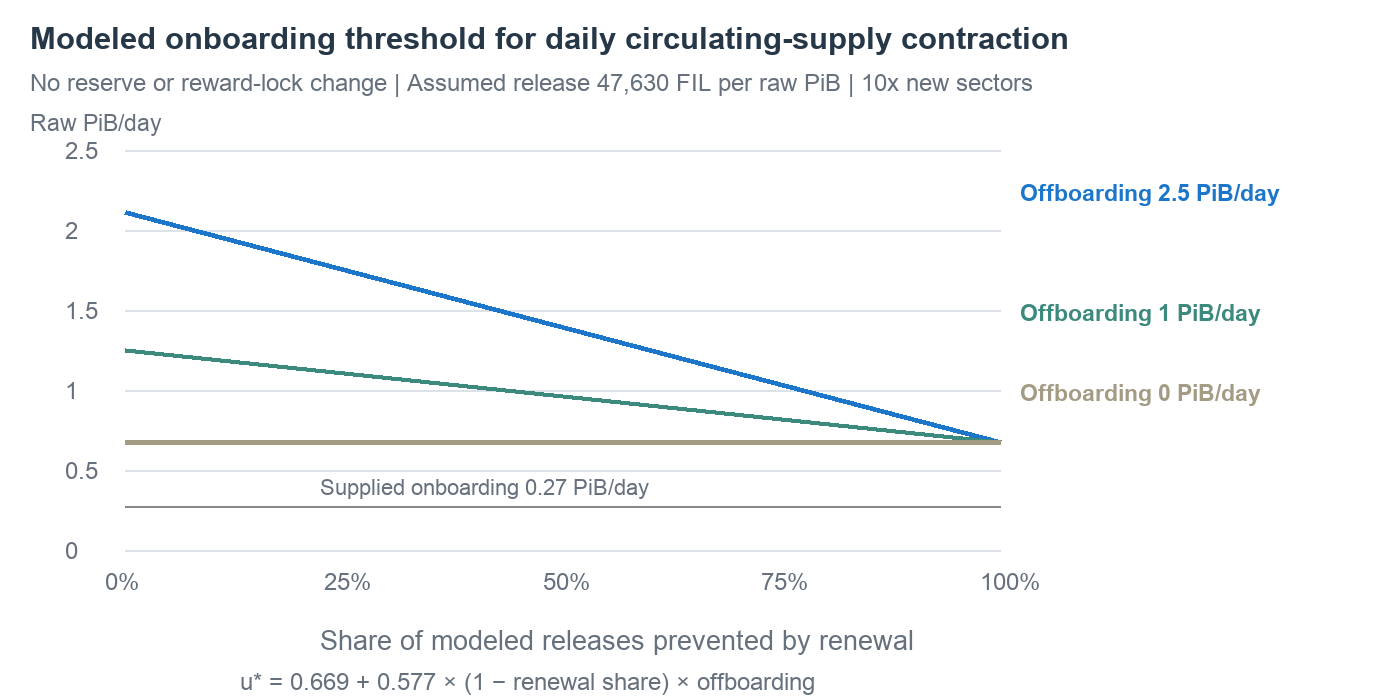
Scenario onboarding thresholds; fixed pledge coefficients and no reserve or reward-lock change
| Regime | Threshold u* | Multiple of current onboarding |
|---|---|---|
| Modeled offboarding 2.5 PiB/day, no renewal | 2.11 PiB/day | 7.8x |
| Modeled offboarding, half prevented | 1.39 PiB/day | 5.1x |
| Modeled offboarding, fully prevented | 0.67 PiB/day | 2.5x |
| Expiry reduced to 1.0 PiB/day, no renewals | 1.25 PiB/day | 4.6x |
| No expirations | 0.67 PiB/day | 2.5x |
In QA terms at 10x each threshold is ten times larger: 21.1, 13.9 and 6.7 QA-PiB/day for no, half and full renewal. Reducing offboarding works through the (1 − γ)e term but cannot meet the threshold alone: with e = 0 it is still 0.67 PiB/day raw, 2.5 times current onboarding.
With no sector releases and no change in locked miner rewards or reserves, new pledge must absorb 55,212 FIL/day. At the assumed pledge rate this is 0.67 raw PiB/day, valued near $52K/day or $19M/year at $0.94. Providers can use existing FIL balances. Additional onboarding in the model replaces the pledge released by offboarding.
The threshold is also sensitive to the pledge rate itself. Writing it in FIL rather than bytes removes the quality multiplier:
With other flows and the release coefficient fixed, the byte threshold is inversely proportional to marginal pledge. A 4.7% increase in new pledge per QAP lowers that threshold by about 4.5%. A small 50x entrant at unchanged QAP would lower the no-release floor to about 0.13 raw PiB/day. A fleet-wide conversion changes QAP and pledge at the same time, so the fivefold result cannot be applied to the full network.
4. Sources of daily supply variation
Daily supply changes can differ from the model’s average because onboarding, releases, reward vesting and burn vary by day. The following are possible mechanisms:
-
Batched locks and concentrated releases. In a hypothetical day with 0.8 raw PiB of new 10x sectors and no releases, about 66,000 FIL of initial pledge would exceed the 55,200 FIL reference inflow. That day would contract if reserves and locked miner rewards were unchanged. It would not establish the monthly result.
-
Burn spikes can produce a negative day when they exceed minting plus net pledge release and other supply inflows. Early termination usually removes gross pledge from the locked stock while burning a smaller fee, so that event normally raises circulating supply by the residual amount. A termination-fee spike alone does not establish contraction. Independent burns can have a different net effect.
-
The end of genesis vesting reduces the inflow that new pledge or burn must offset. Negative days near the cliff are consistent with that lower threshold, but the timing alone does not establish their cause or a change in customer demand.
A sustained regime of ΔCS < 0 requires average net locks and burns to exceed the measured inflows. The model has three channels:
-
Onboarding. The scenario needs 2.1 raw PiB/day without prevented releases, or 0.67 with full renewal. Provider entry depends on net margins, finance and client income; the snapshot does not establish which factor would change first.
-
Pledge per byte. FIP-0081 raises the dominant pledge term when CS/Q rises. FIP-0118 gives qualifying new capacity a 10x multiplier. At 0.27 raw PiB/day, the model needs about 204,000 FIL per raw PiB with full renewal, or 640,000 without, holding the assumed release rate fixed. These are sensitivities, not forecasts of future pledge.
-
Burn. A hypothetical additional residual burn of 25% of the reference reward would remove about 14,200 FIL/day and lower the no-release floor to about 0.50 raw PiB/day, holding other flows fixed. This increment must not already be included in β. Actual residual burn depends on the consensus ramp, service gates and allocations.
The 55,200 FIL/day requirement assumes no genesis vesting, reserve movement or reward-lock change. Lasting contraction depends on measured net flows; the snapshot does not establish it.
Shared data snapshot (Filecoin Data Portal, late October 2026)
| Quantity | Value |
|---|---|
| Circulating supply | 922.35M FIL |
| Pledge collateral | 61.93M FIL (6.71% of circulating) |
| Raw byte power | 1,300 PiB |
| Quality-adjusted power | 11,857 PiB |
| Onboarding | 0.27 PiB/day |
| Block reward | 56,873 FIL/day |
| Burn | 1,661 FIL/day |
| FIL price | $0.94 |
| Filecoin Pay gross payment run rate | $136K to $144K per year |
| Filecoin Pay network fee ARR | $681 |
| Baseline power at 6.03 years | 167,800 PiB |
| Vesting | Ended October 15, 2026 (about 185,000 FIL/day before) |
Code basis is builtin-actors v19.0.1 and Lotus v1.37.0. Onboarding uses raw bytes. Costs of $1 to $8 per raw TiB-month and FIL borrowing rates of 5% to 10% are scenario assumptions, not audited provider costs or executable loan quotes. Dollar and annualized results hold the stated issuance, price and supply fixed unless a time path is specified. The shared snapshot is historical; this review does not replace it with November market data.
The Filecoin economics series
- The Solstice volume gate: subsidy, inflation and the calibration of targets
- Initial pledge per QAP, storage-provider returns and the growth condition
- Conditions for a daily contraction of circulating supply
- Raising the quality multiplier from 10x to 50x: an idea exploration
Source links
Filecoin Data Portal numbers and metric definitions
FIP-0118 reward split, eligible volume and gate timing
FIP-0081 initial pledge decomposition
FIP-0100 sector fee and circulating-supply discussion
builtin-actors v19.0.1 miner pledge and fee code
Discuss This Article With AI
Get instant analysis and insights from leading AI assistants
How We Can Help
Interested in similar solutions for your project? Explore our related services: