What would it cost to stake 80M FIL for Filecoin finality?





Filecoin staking and the storage economy | Data through 26 October 2026
Paying holders a 5% annual return on 80M FIL would deliver 4M FIL to them. With the assumed reward split and operator fee, the pool would need to pay out 4.68M FIL a year. That is 22.7% of the 20.65M FIL annualized from 26 October’s gross block issuance. The return needed to recruit 80M FIL remains unknown. [1, 3]
Filecoin proposes staking for fast finality
The F3 draft proposes weighting fast-finality votes by staked FIL. Block production would still depend on storage power, with Proof-of-Replication unchanged. Fast finality would become binding after about 80M FIL is staked and operator dispersion tests are met for a sustained period. The draft also proposes a 90-day wait after requesting withdrawal. [1]
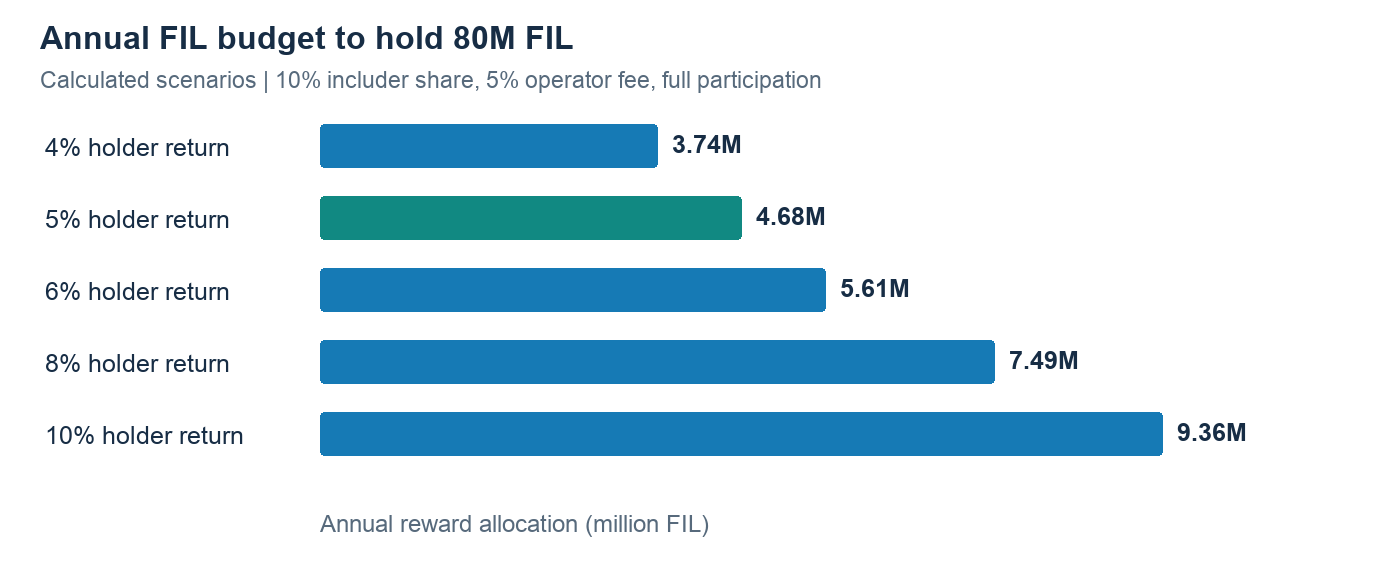
Figure 1. Gross annual payouts at 80M FIL staked, assuming full reward eligibility, a 10% includer share and a 5% operator fee. Holder returns are before claim costs and penalties. [1]
The target equals 8.7% of the 922.81M FIL that the Filecoin VM counted as circulating on 26 October. The share of that supply available to stake depends on who holds it and what they can earn elsewhere. [3]
Filecoin staking must be priced at the return holders receive
The includer is the account that submits a finality certificate on chain, typically a block producer. Let K be staked FIL, y the annual return credited to the holder before claim costs and penalties, a the includer share and f the fee on signer rewards. With full qualifying participation and no compounding, annual payout A is
A = K × y / [(1 − a) × (1 − f)]
At K = 80M, a = 10% and f = 5%, paying holders 5% takes a 5.85% posted rate and a 4.68M FIL annual payout. A direct operator with no pool fee needs a 5.56% posted rate and 4.44M FIL in aggregate. Missed signing rewards, claim costs and expected slashing losses raise the posted rate needed to achieve the same realized return. [1]
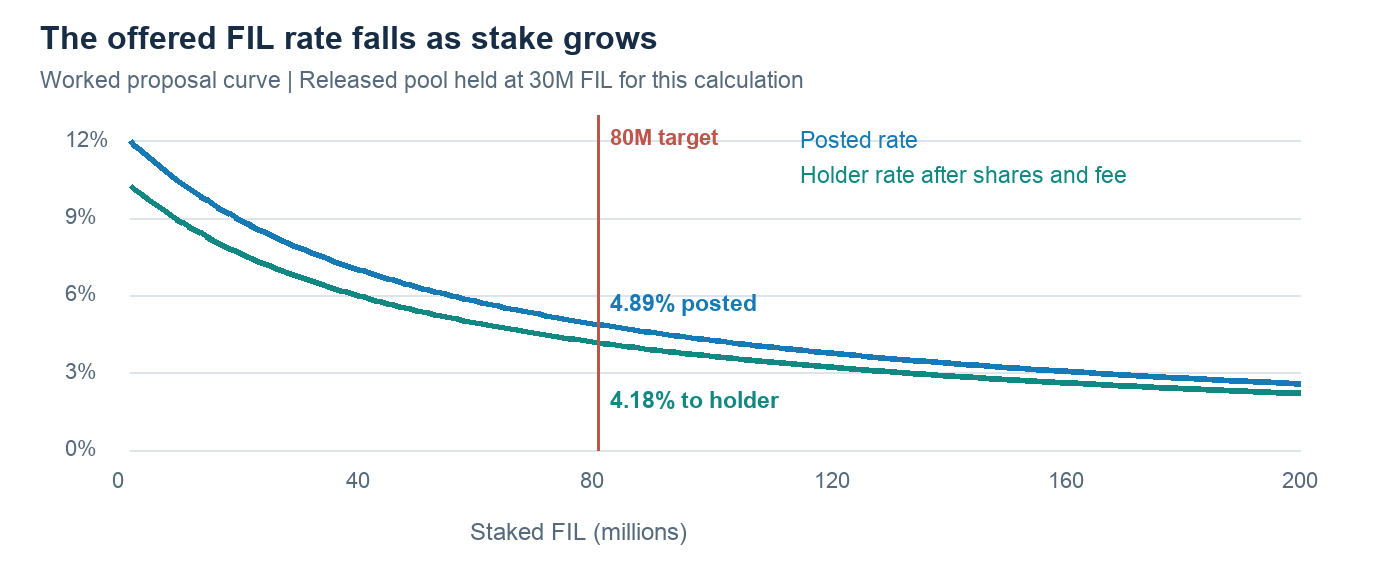
Figure 2. The draft’s rate r = 0.22P / (K + 55M), with released balance P fixed at 30M FIL. The holder line applies a 10% includer share and a 5% operator fee. In operation, scheduled releases add to P and payouts draw it down. [1]
At 80M staked, the curve posts 4.89% gross and credits delegated holders 4.18% before claim costs. With P fixed at 30M, a holder who requires 5% would stop adding stake above 57.9M FIL. That crossing assumes enough willing capital below it. At 80M, a 5% holder return requires a 35.9M FIL released and unpaid balance under the same formula. [1]
A 35.9M launch balance would imply 14.35% at near-zero stake under the formula, exceeding the draft’s proposed 12% opening limit. The launch constants or release schedule would need to change. At 80M stake and a 30M balance, the annualized payout is 3.91M FIL. Qualifying advisory certificates can earn rewards before binding finality starts, so the pool can spend FIL without ever reaching activation. [1]
Filecoin staking funding shifts costs between token holders and providers
At 80M staked, maintaining a 5% gross rate for twelve years costs 48M FIL. Maintaining a 5% holder rate after the stated deductions costs 56.1M FIL. Both calculations cover the twelve-year holding period alone. The draft’s roughly 100M FIL lifetime pool income comes from a thirty-year model with a changing gross rate and stake balance. That model assumes no delegation fee and tests a stylized inflow of up to 5M FIL a month. [1, 2]
The mining reserve adds future circulating supply
The funding paper recommends a reserve commitment of about 91M FIL. Its model shows 38.8M FIL more entering circulation in the first decade than under the committed schedule, before accounting for new staking locks. The reserve already counts toward the 2B FIL cap. The paper assumes a December 2026 Solstice launch, compared with the 19 October activation. Its reported outputs use unpublished model runs. [2, 4]
A reward diversion reduces another use of FIL
The mixed option with the lowest modeled first-decade supply addition commits 48M FIL from the reserve, cuts the service cap to 35% and lowers the provider floor to 25%. It adds 10.9M FIL above the committed schedule in the model. At the new floor, providers would receive half the gross consensus reward they would get at Solstice’s 50% floor, holding issuance fixed. The model holds raw power flat. [2]
A fixed diversion of 10% of 26 October gross issuance would yield 2.06M FIL a year at that day’s run rate. That covers a 5% gross rate on 41.3M FIL or a 5% holder rate on 35.3M FIL with the stated deductions. The comparison freezes issuance and excludes any reserve contribution. [3]
Filecoin’s emission decay raises the future funding share
Simple minting has a six-year half-life. A constant 4.68M FIL annual payout would take twice the share of that stream after six years. Baseline minting also contributes to gross rewards and depends on the history of raw storage power. Maintaining both the stake target and the holder return as emissions fall would require a rising share of the simple-minting stream or another source of funding. [8]
FIL locking must be measured against payouts and capital migration
A staking deposit would take FIL out of the holder’s spendable balance. The funding design keeps that stake in the Filecoin VM’s circulating-supply measure because the VM figure helps set initial storage pledge. The proposal excludes the reward pool’s unpaid balance from circulation and counts rewards when paid. Market-data providers use their own supply definitions. [1, 2, 5]
The net FIL lock depends on where deposits originate
Suppose 80M FIL moves from spendable holdings into stake for a full year and 4.68M FIL in new reserve-funded payouts stays spendable. At year end, spendable FIL would be 75.3M lower than on an otherwise identical path without the program. That comparison depends on who funds the payouts, where deposits come from and how long they stay bonded.
If 20M of the 80M would otherwise have gone back into renewed storage pledge, only 60M FIL represents a new lock against that baseline. After the same payout, the reduction in spendable FIL is about 55.3M. Redirecting rewards already destined to circulate changes the payout comparison. A tradable receipt or loan against stake can also let holders raise funds while the underlying FIL stays bonded.
The required FIL return remains an empirical question
At 80M staked, paying holders 4% to 8% takes 3.74M to 7.49M FIL a year under these assumptions. The Portal recorded about 26.7M FIL in GLIF and a 4.83% iFIL base APY on 26 October. That is a dated lending benchmark with different risks and withdrawal terms. It gives no estimate of how many FIL holders would move into finality staking at 5%. [3]
Part 2 examines the competing use of that capital in storage and the conditions under which provider exits can reinforce FIL price weakness.
Part 1 sources and calculation basis
[1] Stake-weighted F3 draft, sections 1, 3, 5 and 6
[2] Finality funding analysis, options and recommendation
[3] Filecoin Data Portal, daily network metrics
[4] FIP-0118, reward split and implementation
Discuss This Article With AI
Get instant analysis and insights from leading AI assistants
How We Can Help
Interested in similar solutions for your project? Explore our related services: