Filecoin’s provider exits and the risk of a shrinking network





Filecoin staking and the storage economy | Data through 26 October 2026
Filecoin’s raw storage power fell 5.7% from 26 September to 26 October 2026. Over the same endpoints, dollar block rewards per unit of quality-adjusted power fell about 19%. An exit can return FIL to providers who choose to sell. For that to drive a spiral, the sales would have to depress price enough to cut surviving providers’ margins and induce further exits. [3]
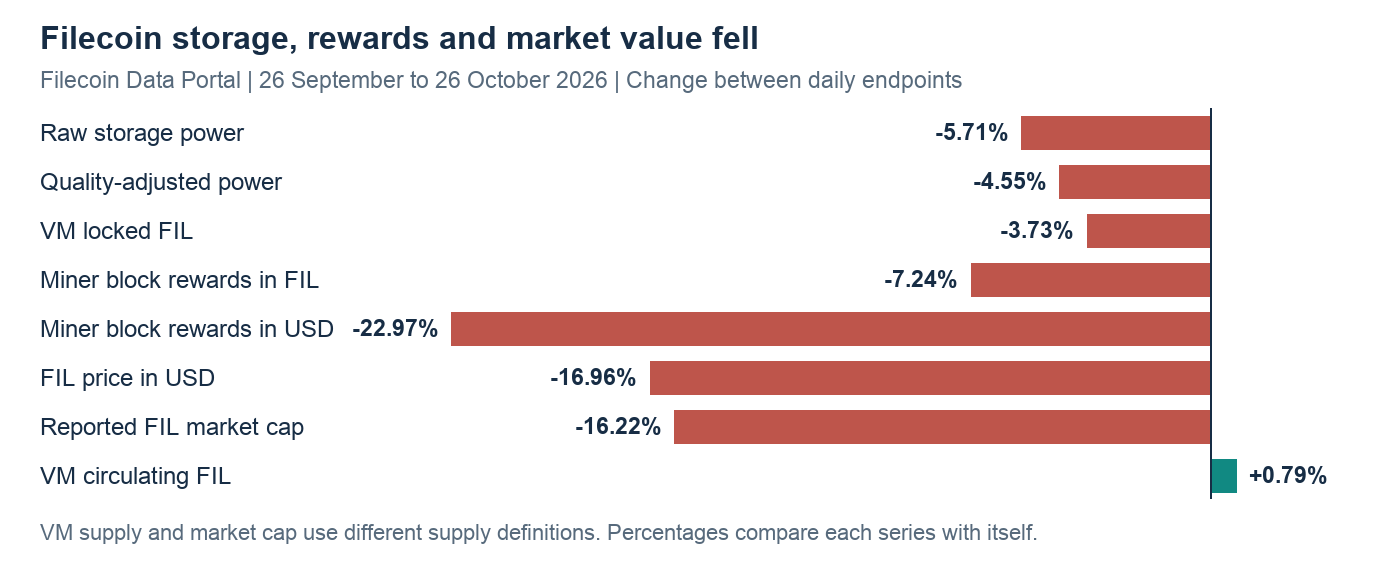
Figure 3. Changes between 26 September and 26 October 2026. Power and VM supply are end-of-day stocks. Block rewards are daily totals. The Portal reports the market cap and VM supply as separate series. [3]
Bitquery counted 517 miner IDs with on-chain storage proofs on the last day of August 2026, down from 4,044 at September 2022 month-end. A firm can run multiple IDs, and the measure depends on proof activity that day. Bitquery also separates legacy deals from direct onboarding, which captures activity the original deal count misses. [9]
Chaince Digital’s Form 10-Q for the quarter ended 30 June 2026 describes a wind-down. Most of its pledged FIL was released after related mining nodes expired, and the company sold a substantial portion for cash. The filing documents one operator’s sales. [10]
Filecoin provider exits raise survivors’ reward share
For a sector with quality multiplier k, a fall in network quality-adjusted power Q increases its expected share of block rewards. Let R be daily gross issuance, w the share paid to block producers and p the FIL price in USD. The expected monthly gross block income per raw TiB is
Block income = p × k × wR / (1,024Q) × 365/12
Q is measured in QA-PiB, with 1,024 TiB per PiB. On 26 October, Q was 11,800 QA-PiB, the average FIL price was $0.913 and miners received 53,522 of 56,566 FIL issued. That gives $1.23 per raw TiB-month for a 10x sector. Holding the other inputs fixed at Solstice’s 50% consensus floor gives $0.65. Solstice activated on 19 October and reaches its floor over roughly nine quarters. [3, 4]
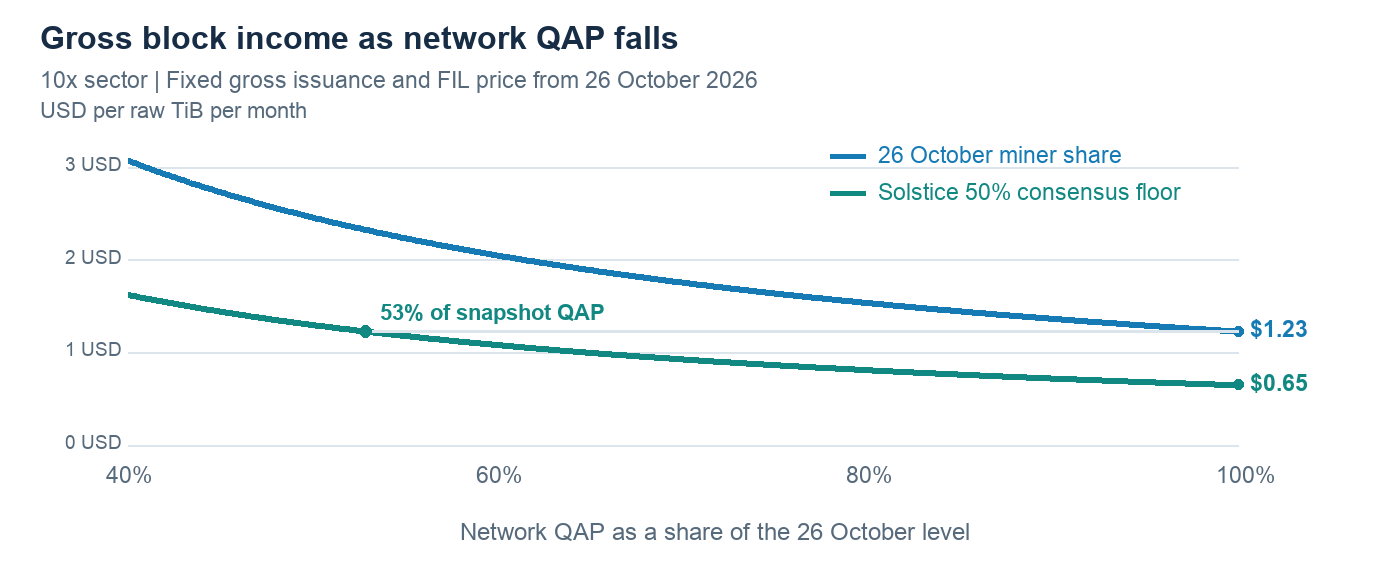
Figure 4. Gross block income for a 10x sector at the 26 October miner share and at the 50% floor. The curves hold gross issuance and price fixed. They exclude fees, operating costs, pledge finance and client income. [3, 4]
At the 50% floor, QAP would need to fall to about 53% of its 26 October level to restore the $1.23 gross income, holding price and issuance fixed. The same percentage would apply to raw capacity only if the fleet’s quality mix stayed fixed.
A provider’s net margin adds client revenue and subtracts operating costs, sector fees and pledge financing. Block rewards also vest over time, so their dollar value at the daily price differs from cash available to pay bills. The reward-share calculation alone leaves the economics of renewal open. [12]
Pledge releases can expand FIL supply while FIL market cap falls
With issuance, allocation and sector quality held fixed, dollar block income per raw TiB varies with price divided by QAP. A 4.55% fall in QAP offsets a price fall of the same size. A larger price fall reduces gross block income, and a lower miner allocation reduces it further. A self-reinforcing exit cycle requires the price fall to come from those exits and to cause more non-renewals or terminations.
Filecoin’s recent reward relief was smaller than its price decline
From 26 September to 26 October, FIL price fell 16.96%, miner rewards fell 7.24% in FIL and QAP fell 4.55%. Dollar rewards per unit of endpoint QAP fell 19.3%. Gross minting fell 1.96%, and Solstice began redirecting a share to services during the window. The comparison uses two daily run rates and combines the effects of price, emissions, allocation and power. [3, 4]
FIL circulating supply and exchange liquidity measure different things
VM circulating FIL rose 0.79%, from 915.54M to 922.81M. The Portal’s market-cap series fell 16.22%, from $913.7M to $765.5M. The market series uses a different supply basis from the VM. Multiplying the October VM balance by the Portal’s October price gives about $842.5M, compared with $765.5M in the reported market series. [3]
Exchange liquidity is the ability to trade with limited price impact. Released pledge can increase the amount of FIL holders can sell without increasing bid depth. Volume records trades that took place. Estimating how much a wave of sales would move the price requires trade or order-book data.
FIL stock changes must be separated from FIL flows
VM locked FIL fell by 2.38M over the window. The Portal labels the same series pledge collateral. It is a net stock change and includes changes in locked miner rewards. Separately, 71.4 raw PiB expired, 19.7 PiB terminated early and 10.9 PiB were onboarded over the 30 days. Those capacity flows do not identify how much pledge reached exchanges or was sold. [3, 11, 12]
FIL staking can attract capital that would otherwise renew storage
At renewal, a provider can compare the expected cash margin from running a sector with the return it could earn on the pledge after expiry. Client obligations, financing terms and the unbonding period affect that choice. If finality staking attracts pledge that would have funded renewals, the same FIL can support finality while less capital backs storage.
FIP-0098 sets an early-termination charge of 8.5% of initial pledge for mature sectors, subject to the protocol’s fee bounds. Natural expiry avoids that charge. A staking offer can therefore alter a renewal decision even when exiting early would cost too much. [7]
FIP-0081 ties part of new initial pledge per QA byte to VM circulating FIL divided by network QAP. Falling QAP raises that component at fixed supply. The effect is on the FIL required for new commitments. Applicable daily sector fees under FIP-0100 and the cost of obtaining FIL also enter the renewal comparison. [5, 6]
A price-driven spiral requires evidence of repeated feedback
Evidence for repeated feedback would link falling net margins to subsequent exits, trace released collateral into sales, and estimate the price impact relative to the reward-share relief. The October endpoints and the Chaince filing establish pieces of that sequence. Operator ownership, customer renewals and exchange depth would help distinguish network damage from unused capacity leaving. [3, 9, 10]
At a 5% holder return, the 80M FIL staking scenario requires 4.68M FIL a year. Reserve funding adds future payouts. The mixed funding option would cut provider revenue further, and attracting storage pledge that would otherwise renew would reduce the extra FIL locked. The effect on storage and spendable supply depends on funding and who stakes.
Part 2 sources and calculation basis
[3] Filecoin Data Portal, daily network metrics
[4] FIP-0118, reward split and implementation
[5] FIP-0081, initial pledge formula
[6] FIP-0100, daily sector fee
[9] Bitquery, Filecoin storage investigation, September 2026
[10] Chaince Digital, Q2 2026 Form 10-Q, mining operations
[11] Lotus v1.37.0, VM circulating supply
[12] Miner actor v19.0.1, block reward vesting
Read Part 1: What would it cost to stake 80M FIL for Filecoin finality?
Discuss This Article With AI
Get instant analysis and insights from leading AI assistants
How We Can Help
Interested in similar solutions for your project? Explore our related services: