FIP-100 Ten Months In: What the Data Actually Shows





Key Takeaways
- •Batching adoption is FIP-100's clearest win, with fuller-batch rates rising from 3% to 80-90%
- •Gas savings are real, but gas is one cost component among several — the full picture includes hardware, collateral, and FIL price
- •Rising BR/sector is a denominator effect: onboarding dropped 80%, not a sign of improving economics
- •The path back to growth will require progress on economic and commercial fronts, not just protocol optimization
FIP-100 Ten Months In: What the Data Actually Shows
FIP-100 went live with nv25 on April 14, 2025. It removed the batch balancer fee and aggregate ProveCommit fee, making batching and proof aggregation economically rational at all base fee levels. The expected result: ~3.6x gas reduction for batched PreCommit and ~2x for aggregated ProveCommit. Hard protocol batch-size caps were also lifted.
Ten months later, Tanisha's community dashboard provides a solid dataset to evaluate what actually happened. We reviewed every chart. Here's what the data shows and where the original hypothesis holds.
Storage provider participation: no FIP-100 impact
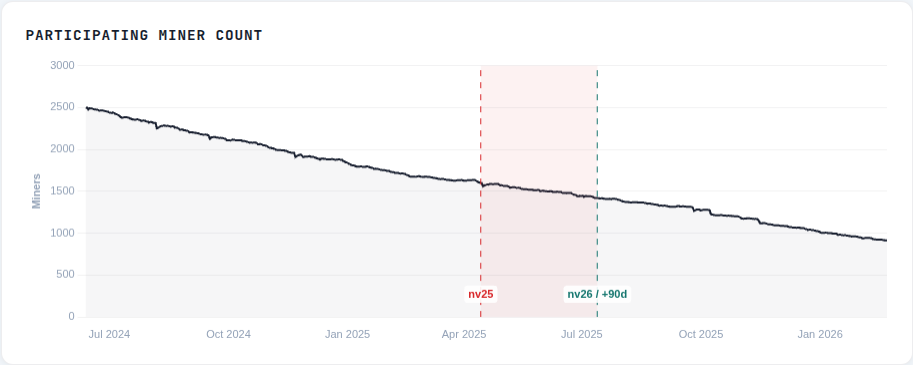
A key question for any protocol upgrade is whether it disrupts the existing operator base. The miner count chart helps answer this for FIP-100: the SP participation trend predates the upgrade entirely.
From July 2024 to nv25 activation in April 2025, participating miners declined from roughly 2,500 to 1,600 — a rate of about 90 per month, driven by broader market conditions. Post-grace-window (July 2025 onward), the rate actually moderated to about 65 per month.
| Period | Change | Duration | Monthly Rate |
|---|---|---|---|
| Pre-nv25 (Jul 2024 – Apr 2025) | ~900 | 10 months | ~90/month |
| Post-grace (Jul 2025 – Feb 2026) | ~450 | 7 months | ~65/month |
There is no inflection point at nv25, and no inflection at the grace window end. FIP-100 did not accelerate SP departures — but it didn't slow them either. The participation trend reflects broader market conditions, and the slight moderation post-activation (90/month to 65/month) is within normal variance. A brief plateau around nv25 could indicate operators pausing during the grace period, but the downward trend resumed. Gas fee reform was never going to reverse this. FIL price, collateral requirements, and storage demand are what drive participation decisions.
Batching adoption: FIP-100's clearest win
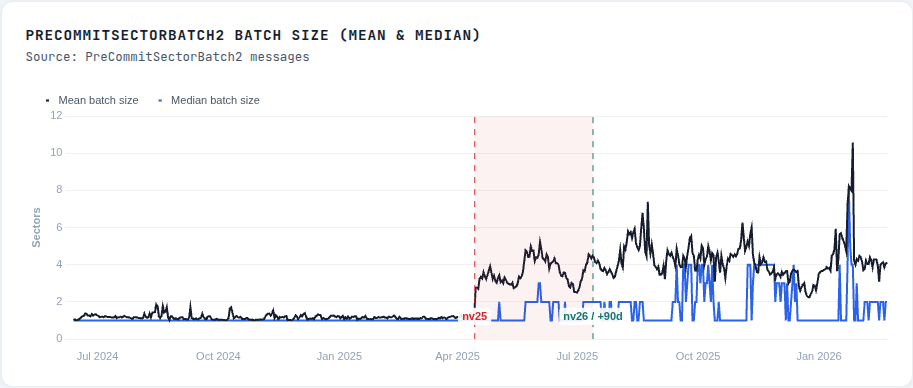
Pre-nv25, mean batch size hovered around 1. Miners were submitting single-sector PreCommit messages because the batch balancer fee made batching economically irrational at low base fee levels. That changed immediately at nv25. Mean batch size jumped to 3–4 with regular spikes above 8.
The fuller-batch metric makes this even clearer:
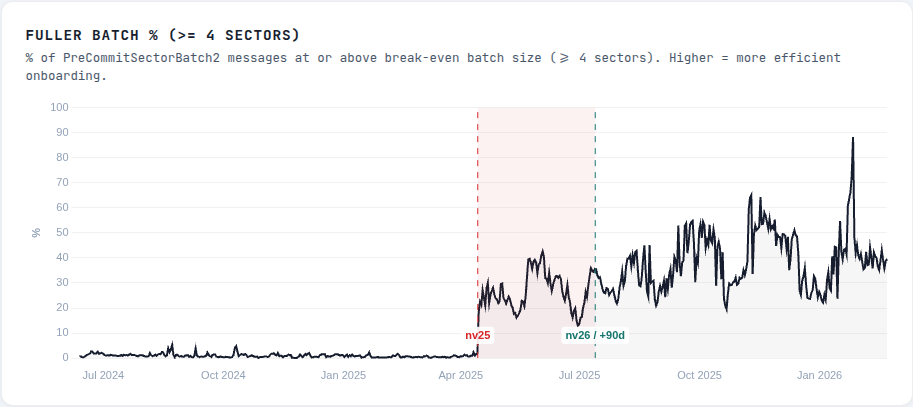
Before nv25, fewer than 5% of batches hit the 4-sector break-even threshold. Post-activation that jumped to 30–40%, and by January 2026 it was hitting 80–90%. The adoption curve is still steepening ten months post-activation, which suggests continued behavioral adaptation rather than a one-time jump.
This is the result FIP-100 was designed to produce. Removing the fee distortion made batching the rational default, and miners responded accordingly.
A caveat on materiality
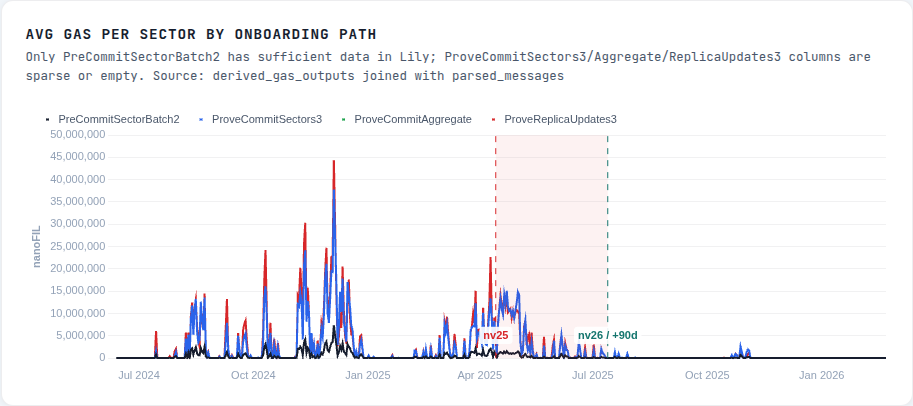
The gas-per-sector chart shows that pre-nv25 costs spiked up to 45M nanoFIL per sector. That's real money for large SPs onboarding thousands of sectors. But gas is one component among several — hardware, collateral, and FIL price all weigh on SP economics too. FIP-100 fixed a genuine distortion in how gas was charged, and that's worth doing on principle. The question is how much of the overall cost picture this addresses, and the honest answer is: it helps, but it's not the whole story.
Block reward per sector: a denominator story
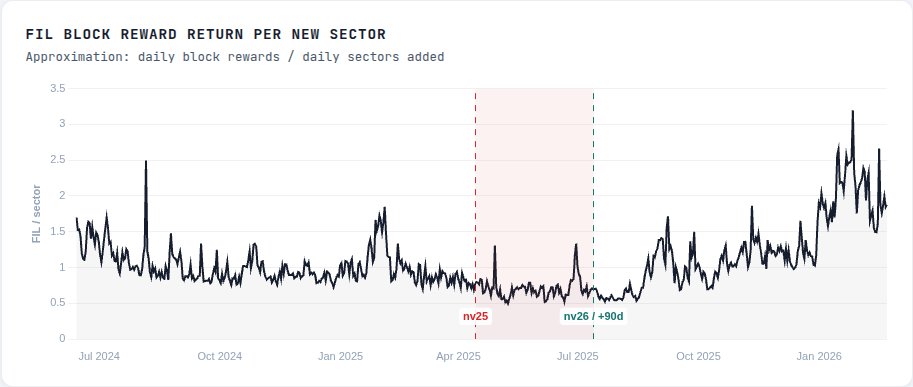
BR/sector has risen from 0.5–1.5 FIL pre-nv25 to 1.5–3.0+ FIL by early 2026. This is worth understanding carefully: the increase is primarily a denominator effect rather than a direct FIP-100 outcome.
The metric is daily block rewards / daily sectors added. Onboarding volumes have decreased over this period:
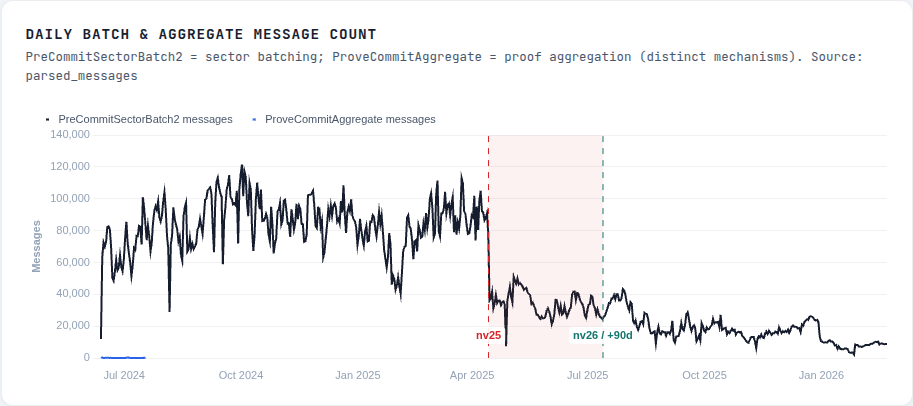
Daily batch messages dropped from 80–100K pre-nv25 to 10–20K by late 2025 — an 80% decline in onboarding activity. Block rewards decline more gradually on Filecoin's baseline emission schedule, so fewer new sectors sharing the reward pool mechanically produces higher BR/sector.
This is not a FIP-100 outcome, and it's not straightforwardly good news. Higher yield per sector makes the math better for SPs who stay, but the reason the yield is higher is that most onboarding has stopped. Presenting improving unit economics without that context would be misleading.
Signals worth watching
The nv25 extension mega-spike
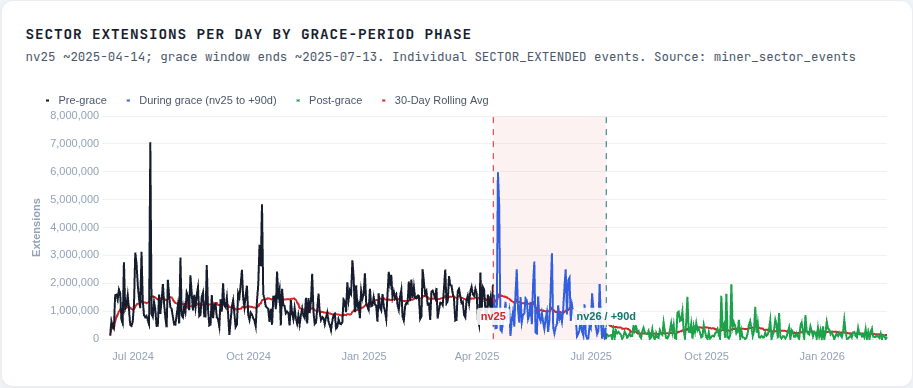
On the day of nv25 activation, roughly 6 million sectors were extended in a single day — dwarfing typical daily volumes of 1–2 million. Miners rushed to lock in pre-FIP100 terms before the DailyFee mechanism kicked in. This is the strongest behavioral signal on the dashboard: storage providers were aware of and actively responding to FIP-100, even as the aggregate network trend was unchanged.
Post-grace expiry emergence
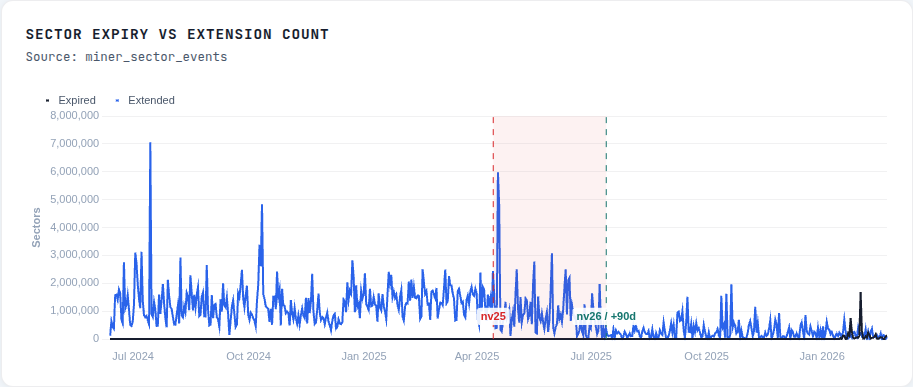
The expiry vs. extension chart shows a notable shift post-grace. Before nv25, extensions dominated with near-zero expiries. Starting around January 2026, expiry volumes spike significantly. Miners appear to be making economically rational decisions to let low-value sectors expire rather than renew under the DailyFee regime. This is distinct from the SP participation decline discussed earlier — operators aren't leaving the network, they're pruning individual sectors that no longer justify the cost. If so, the DailyFee is doing what it was designed to do: helping SPs differentiate between sectors worth maintaining and those that aren't.
Raw power: flat, not growing
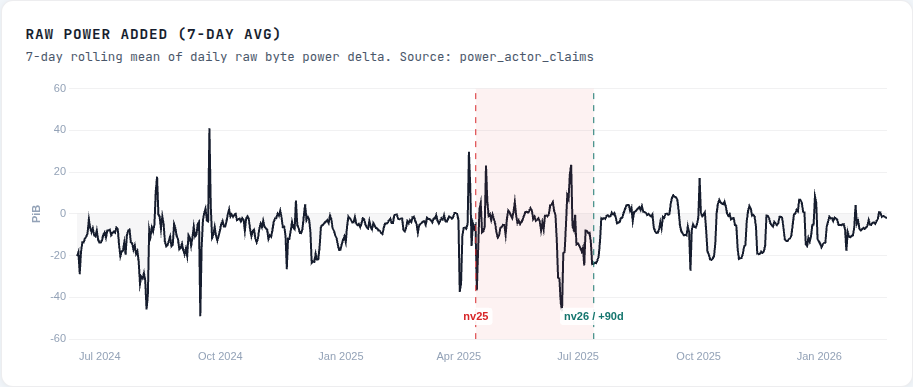
Raw power delta has oscillated around zero for the observation period, consistent with broader market conditions. The range of raw power swings has halved post-grace (90 PiB to 44 PiB), with fewer extreme outlier days, though typical day-to-day variance remains similar (standard deviation: 8.8 PiB pre-nv25 vs 7.6 PiB post-grace). The network has stopped producing -49 or +41 PiB outlier days, even if the baseline churn is unchanged. Power hovering at zero means the network isn't shrinking, but it isn't growing either. Returning to net-positive growth will likely depend on factors beyond gas efficiency.
Summary
| Metric | What the Dashboard Shows | Assessment |
|---|---|---|
| SP participation | Steady trend, no inflection at nv25 | FIP-100 did not disrupt the operator base |
| Batching adoption | 3% → 80-90% fuller batches | FIP-100's clearest win; achieved its design goal |
| BR per sector | Rising post-nv25 | Denominator effect from reduced onboarding, not a direct FIP-100 win |
| Gas per sector | Drops significantly post-nv25 | Real but modest relative to total SP costs |
| Extensions at nv25 | ~6M spike on activation day | SPs actively engaged with the upgrade |
| Post-grace expiries | Emerging in Jan 2026 | DailyFee may be driving rational sector management |
| Raw power added | Hovering around zero | Range halved (90→44 PiB); extreme outliers gone, but no growth |
FIP-100 did what it was designed to do: remove the batch balancer distortion and make gas-efficient onboarding the rational default. On that narrow objective, it clearly succeeded — batching adoption is still climbing ten months in.
However, SP participation continues to decline, onboarding has dropped significantly, and power is flat. These are broader challenges driven by FIL price, collateral requirements, and demand for Filecoin storage — areas where gas fee reform alone has limited reach. FIP-100 fixed a real inefficiency, and the DailyFee appears to be introducing healthier sector lifecycle management. That matters. But the network's path back to growth will require progress on the economic and commercial fronts as well.
The community dashboard is a valuable resource for ongoing monitoring of these dynamics.
This analysis was conducted by CryptoEconLab. Dashboard data sourced from Tanisha's FIP-100 Dashboard. For more on Filecoin economics, storage provider strategy, or mechanism design, reach out at advisory@cel.build.
Discuss This Article With AI
Get instant analysis and insights from leading AI assistants
How We Can Help
Interested in similar solutions for your project? Explore our related services: